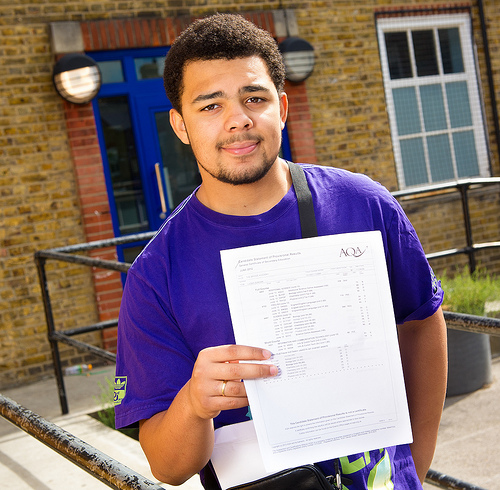
On GCSE results day…

Image

Photo Credit: Hammersmithandfulham, Creative Commons

Your grades will not affect your future so much as your attitude and your determination. If you can sharpen these two characteristics you will increase your chances of success in many areas of life – not just your career.

Who you are as a person will always be infinitely more memorable to those whom you meet than how many ‘A’ grades you achieved at 16.

Don’t waste time comparing yourself to others who sailed through and clinched straight As. You may well have talents and abilities beyond the restrictions of an exam paper. Remember that many highly successful people – entrepreneurs, artists, politicians – did not achieve well at school. Read more about that here. This is also worth a read. (American spelling)

Decide now that you will not let your grades – however good or bad – become the benchmark against which you measure yourself. In the grand scheme of things, these grades in your hand today are not necessarily a reflection of you or your future. They are only a small part of your story. Now it’s time to move on. Make decisions, take re-takes if you think that’s what you should do, and focus on developing new skills. Aim for new heights and enjoy new experiences.

Above all, focus on the good things in your life, not the negative. Don’t let disappointment cloud your optimism for other hopes and dreams.

And if you achieved the grades you wanted – well done! You worked hard and things worked out for you. However, remember that you will not always gain what you want in life; sometimes doors will be closed to you and you will also taste disappointment in one way or another. Be considerate of others and have some empathy towards those who are not feeling quite so elated as you.

The Power of Negative Thinking/ An Anecdote

Photo Credit: JBYoder, Creative Commons

Photo Credit: JBYoder, Creative Commons

We were staying at a delightful holiday cottage in Wales, where I lay in bed gazing at the magnificent view across the hills. When I finally decided to pull myself out from under the duvet, I called out across the landing (hall), to no-one in particular: “Who will make me a cup of tea? I’d really like some tea!”

My fourteen year old son sprang out from his bedroom and, with a glint in his eye, eagerly replied “I will!”

As soon as he responded, I instantly remembered our visit to a gift shop the day before, where all three boys were enthralled by the vast array of goodies to be found, not in the sweet section, but in the few shelves devoted entirely to joke and trick items. From fake blood capsules to super spicy boiled sweets, it was sheer boy heaven.

As Dan brought me the mug of tea a few minutes later, with a broad grin on his face, I knew he had spiked the drink with a sachet of tea laced with laxative (otherwise known as a ‘Dr Crapalots tea bag’!) I glared back at him, revealing my concern at his offer. He laughed.

“Oh well”, I thought, “it can’t be that bad” – my younger son had drunk a whole cup full the evening before to no drastic ill effect.

My feelings of thirst overcame any hesitation and I began to sip the concoction. Mmm, it did taste a bit weird. Nothing like my favourite Earl Grey brew. As I continued to drink the tea, I felt as though I could actually taste some traces of liquid laxative. Halfway through the mug, I told Dan that my stomach was feeling queasy and that the tea really was unpleasant.

Dan found my response hilarious. “Aha”, he snorted, “It’s not even the joke tea bag!”

“Well what is it, it tasted so different?! Was it the PG Tips left in the welcome pack?” I inquired.

“No! It’s Earl Grey! Ha, I fooled you, haha!”

I honestly couldn’t believe what I was hearing. He’d brought me a cup of my favourite tea, perhaps slightly weaker than I would make it, and I was so convinced that it was a sachet of ‘Dr Crapalots’ that my taste buds rejected the flavour and waves of nausea came over me! Dan was delighted, he called it a ‘double prank’.

I stared at the cup in my hand, the feelings of rumblings in my stomach subsided, and I promptly enjoyed the rest of my tea. No further problems.

That little episode demonstrated to me how negative thoughts can wreak havoc with our minds and our bodies. Fear has been described as ‘False Evidence Appearing Real’. In this instance, the thing I feared started to become reality, affecting my taste buds, my stomach and my mind. I simply couldn’t enjoy the cup of tea that I would normally relish first thing in the morning.

How true that our thoughts have power to affect our feelings and our responses. Negativity often holds power that it shouldn’t possess. We concede power to it.

As I drank the rest of that tea with a smile on my face, I snatched back the power. Negativity lost.

Copycat Christianity – It just doesn’t cut it/ FaithWalk

Images from Tianducheng, central China – a developing city…
(For more images, see here.)
Credit: matthewniederhauser.com
Photo credit: photomonde.fr
French style apartments

Much like these images of a misplaced, replica Eiffel Tower and European architecture amidst farmland in central China, perhaps we would do well to consider the ridiculous and futile efforts we make to look like other churches, organisations or individuals.

It all starts with the best of intentions. You can just imagine the town planning meeting in Hangzhou, Zhejiang Province, as officials lay out their visions of a European style setting, complete with fountain, statues and monuments designed in the image of central Paris. “It will be styled on the exact originals!” they gush, as the participants marvel over the accuracy and likeness of the plans. “It will draw thousands of inhabitants and visitors! People will love it!”

Sadly, not so. As you see the photographs of the new Chinese town development, at first glance appearing to resemble the French version, on closer inspection it soon becomes apparent that the comparisons fall woefully short of the original. For what is the Eiffel tower, without the Seine river? What is the European style fountain without the feet and voices of hurried French people milling around? What is the intricacy of the apartment exteriors without all the other sights, sounds and scents of that unique hive of true Parisian culture and history?

Frankly, Tianducheng seems rather odd; it just doesn’t measure up. The Chinese mini-Paris is sadly lacking in so many aspects. Even the indigenous population has failed to be impressed with the design, while the developers have been disappointed that dwellers have not flocked to their copycat city.

And yet, even if it did manage to rid itself of the farmland, the dirt roads and the litter, it still would fall grossly short of the original. For there is also something in the atmosphere when you walk the streets of Paris. From the smell of fresh crepes and fresh baguettes to the music spilling out from cafes or street performers, to the traffic along the Champs Elysees or mopeds whizzing around the Arc de Triomphe, or the sound of gentle French language from the tongues of quintessential, stylish French people. All these things blend in to make Paris, Paris.

You would feel immensely cheated to find yourself holidaying in this mock version of the city rather than the original.

Most of us would likely think it would have been better if the Chinese had simply come up with some new ideas of their own, even if they wanted to base their plans on some of France’s structural or creative ideas. Why not design their own monument, their own water feature, their own stylish buildings? Why not instigate whole new expressions of culture altogether?

In similar fashion, it occurred to me that so often we feel the need to style ourselves on others. It’s easy to see the glowing talents, skills or ministries of leaders or high profile Christians and start to entertain thoughts of emulating their highly regarded traits or successes. But why do we do this? Why compare our gifts or abilities with others or even start wishing to be like someone else who may seem to have all the credentials of a successful Christian, when it’s quite clear that we are unique in our own right? Why try to build replicas of others’ works?

How crucial to remember that we each have our own gifts to develop, our own life vision to pursue and our own influence to shape those around us. We may not be the budding human equivalent of an acclaimed Capital city, but rather a quirky village or trendy town, or bustling street. But at least we can be an original – not some second rate version of somebody else.

For we are God’s masterpiece. He has created us anew in Christ Jesus, so we can do the good things he planned for us long ago.” (Ephesians 2:10, New Living Translation)

The enormity of this Bible verse strikes me. God has envisaged some stuff for me personally to fulfil or create. He has a tailor made, individual plan for my life, which I need to discover through being sensitive to his leading and guidance. Yes, there may be some similarities with those around me, but there will always be specific or unique things that God has in store for me to fulfil. The images of my life should blend together to create a stunning masterpiece, designed by God himself!

If ever you’re tempted to doubt your own abilities or potential, or think it might be a good idea to be a carbon copy of another person, take a look at these pictures of a disastrous mini-Paris, Chinese style!

Staying sane in the summer – How to occupy young kids in the hols

Photo Credit: Brit, Creative Commons

Photo Credit: Brit, Creative Commons

It’s day three of the holidays and the weather is not looking promising.

Your baby is learning to crawl into places not designed to be child friendly, your toddler is whining for something to eat – again – and has already had two toilet training mishaps this morning.  Meanwhile, your eldest has decided to make it his mission in life to annoy his siblings in any shape or form, which usually leads to the production of agonising shrieks several decibel levels beyond health and safety standards.

The house, which vaguely resembled some sense of order just a couple of hours ago, is now descending at break-neck speed into utter chaos. … And to think you used to be pretty organised and in control! And there’’s another 5 or so weeks of this to go still – Aaarrgggg! If you’’re in need of some ideas on how to navigate the jungle of kiddie-dom and survive the summer holidays, read on….

Devise a plan

Just like at school,– divide the day up into sessions. Morning, lunch, afternoon, tea. It may sound obvious, but it’’s easier to manage “chunks” of a day than thinking “what on earth am I going to do with the kids all day today?” It doesn’’t mean you have to micromanage every single activity your children are engaging in, it’’s more a case of being one step ahead when they seem fed up and start misbehaving: you’’ll already have something up your sleeve to help occupy them rather than despairing “over why they can’’t just go off and play nicely?” When you hear that wonderful phrase that you really wish your 4 year old hadn’’t learnt –  ““I’’m bored!””, you’’ll be able to come up with something of a convincing response. A great idea is to list all the various possible activities for indoor or outdoor play. You may be surprised at how long your list gets. Ours includes things like: make a poster, have a music/singing session, go for a long hike, and have a water pistol fight.

Boredom Busters

Save a couple of surplus toys or gifts from birthdays or summer fêtes especially for rainy days – e.g. play-dough kit, pack of cards, jigsaws. Alternatively, ask the grandparents to bring such items instead of sweets when they visit (this will have the added bonus of helping to keep their hyperactivity levels down). Or you can always go to the pound store one day and stock up on funky crayons, colouring books, bubbles and plasticine. Instead of just forming shapes with plasticine, my youngest son loved making imprints with various toys and models. Think creative.

Sure-fire hits (for free)

I’’ve never met a child that doesn’’t enjoy hide and seek or a good old tickle fight. You will be one popular parent if you’’re willing to do some silly stuff with your kids occasionally. The squeals may be loudest when you chase them around the house wearing a makeshift mask and wielding a tea-towel or a cardboard tube, but the smiles will be worth it! Another idea for older ones: get them to set up an assault course in the garden and have fun with a stopwatch to see how quickly they can complete the course. Dressing up & role play can also be fun for all ages up to 10; you can enjoy creating outfits from some old clothes or curtains. And don’’t underestimate the fun to be had from setting up “camp” in the living room or under the dining table.

Always go out

Even if it means digging out wellies from the cupboard and huddling under umbrellas in pouring rain to post some letters and pick up some milk from the corner shop. The day will go much quicker if you get out even for only half an hour. All day stuck inside with one, two or more kids is enough to drive even the sanest of people somewhat stir crazy. You never know, you may even bump into another adult for a couple of minutes of real conversation! However, don’t be tempted to consider prolonged shopping sprees as a viable way to pass the time! Try to keep visits into town short and sweet, leaving enough time to get back home before a toddler starts kicking off. As ever, timing is crucial.

Go on a picnic

You get fresh air, a chance for running off beans and all the crumbs cleared up in one easy move. Phone a friend to join you, and then you’’ve also got someone to watch your kids if you need to take one to the loo or change someone’’s nappy. We do picnics at least once a week during the hols, and sometimes have a picnic in the garden as a spin off version.

Bargain with the older ones

For example… ‘If you want me to play swingball, Pop-Up-Pirate or build Lego with you, please put away XYZ first, or play with the baby for 15 minutes first. Oh, you’’d like an ice-lolly? Absolutely, why not! But first you need to clear up all those crayons and cut up pieces of paper’. Don’t just give them something for nothing all the time (apart from love, that is). That way, they’’ll learn some responsibility as they grow up and start to see that life doesn’’t revolve around them and their wants.

Play dates

Even though the noise gets doubled and the possibilities for arguments increase, you’’ll get a buzz out of seeing that your kids actually aren’’t the naughtiest in the world and at the same time enjoy being with someone taller than three foot who’’s capable of discussing something more intelligible than Moshie Monsters or The Hoobs. You’’ll come home feeling somewhat revived and cheerful too, having spent an afternoon with a fellow parent. Just avoid talking about the kids all the time; how about politics, gardening or the theatre for a change?

Save the TV or DVDs…

…For when you desperately need some peace and quiet or when a young one really needs to calm down from a busy day. It’’s also great to save it till 30 minutes before you go out. Kids get a chance to recharge their batteries before, say charging around the park, while you get the chance to get all your stuff ready without little ones distracting you every 6.4 seconds. So – use TV time to suit YOU and your plans, not just because your child feels like it at any random moment.

Say yes to offers of help that come your way

…whether it’s that older friend from toddler group, mother-in-law, nice neighbour down the street, or even your partner willing to take off Wednesday morning to give you a break in the week. And if you see a holiday club advertised outside a local church, where your school-aged children can go for free for a couple of hours each day, then why haven’t you signed up for it yet? (Just check their credentials and procedures for child protection to ensure they’’re worthy of taking care of your precious offspring.)

Be voucher savvy

Be sure to cut out and save coupons or vouchers for the occasional trip to the zoo or theme park. They tend to be found in mags such as the ‘Term Times’ which are given out to school children. Doing so could well save you quite a few pounds and pence, leaving you with some extra cash for ice lolllies and other treats.

So let the fun begin, and at the end of each day make sure you reserve some time and energy for a child-free pursuit that you enjoy. And remember – even if your day has seemed like a bit of a disaster – each morning is a fresh start to think positively and a chance to re-connect with your children by engaging in their world.

This article first appeared in the now defunct webzine ‘LookingatLife’ in 2008, under the heading ‘How to Occupy Your Kids’. This is an amended version.

Bartoli and the BBC/ Words Matter

Marion Bartoli and Andy Murray at the Champions’ Ball

I dread to think what I’d look like sans make-up in a white mini skirt on Centre Court at Wimbledon, having run around like crazy, swiping balls back at my opponent for an hour and a half. Add in a few frowns of concentration and some beads of perspiration, along with several focused grimaces, and I’m quite sure I’d not look a pretty sight.

Most of us accept the fact that Marion Bartoli, the 2013 Women’s Singles champion, was not on court to look pretty and that that was the last thing on her mind throughout the tournament. Yet some of the vitriol directed at her by mindless would-be commentators at home and the thoughtless comment from the BBC’s John Inverdale, suggesting live on air that she was not much of a ‘looker’ is shocking and regrettable. No wonder 674 viewers responded irately to the insensitive gaffe. I didn’t come across any unkind comments in the news regarding male players’ appearance or attractiveness. Bartoli’s stunning transformation at the Winner’s ball after the Championship may well have silenced some of her critics, but I don’t see why she had to prove anything at all. It’s not like she had tried to win a modelling contract; she’s a tennis player for goodness sake!

Fact is, there are times when we should just keep our thoughts to ourselves. What right do any of us have to name call and belittle others on the basis of their appearance? Unfortunately Bartoli’s experience was not unique to her; countless women face judgements on their looks on a daily basis. Female politicians and high profile women in media or business are frequently subjected to commentary on their appearance rather than their capabilities. The rise in social media has in no small part contributed to people’s tendency to broadcast mean or critical comments that they wouldn’t dream of vocalising in public.

Although Inverdale and the BBC have apologised for the above quote, the effects of the words still linger. I once read an analogy about the power of words, likening them to toothpaste that has been squeezed out of the tube. Once the substance has come out, it’s incredibly difficult to push it back in without leaving a big mess. That’s what our words are like. We may try to retract them or to apologise, but once they’ve passed our lips (or keyboard), they are hard to ignore or forget.

I’m aware of this myself, having spoken countless thoughtless words and regretted them. Thankfully, I don’t appear on live TV or radio and only a few have been on the receiving end of my ill advised comments or outbursts.  I’m reminded of the old adage, favoured by grannies and those of a previous era: “If you haven’t got anything nice to say, don’t say anything at all!” Wouldn’t it be good if that once again became a consistent maxim for the media – and for the rest of us – to follow before rushing to make announcements about people’s outward appearance? The BBC could perhaps also consider whether its presenters would benefit from some refresher training courses in how to avoid sexism and inappropriate comments.

The Money Trap – Why politicians’ pay should not be attractive

Image

In the news this week there is much furore over the issue of MPs being awarded a potential £10,000 pay rise. This at a time of major cuts and austerity across public services in a drive to reduce the national debt.

As their current salary stands at £66,396, MPs already earn nearly £40,000 above the national average, and with a plethora of perks – such as travel expenses and an additional residence in London – it would seem that a career in politics is quite an attractive option.

Which is exactly what we don’t want.

We need the right calibre of people going in to politics, to lead the country well and to make the decisions which benefit us all. Those with noble intentions and worthy characteristics such as integrity, wisdom, diligence and a genuine concern for their constituents. Those who are more concerned with doing the right thing than obsessing over their public image or the desire to climb the political ladder. MPs who will follow their convictions rather than the party whip; who will speak their minds rather than contrived political sound bites.

Thankfully, we still have some such politicians, though I fear they are becoming a minority.

What kind of leaders will govern us from Parliament if an MP’s salary becomes around two and a half times that of a teacher? (Teacher earning approx 31k in inner London after a few years.) Unfortunately, corruption and cockiness spring to mind.

Perhaps MPs should consider drastically reducing their pay to match that of teachers and nurses – those who generally go into the profession for commendable motives, and who want to make a difference.

It seems that now would be a good time to start a major shake-up in British politics if the government is to revive any widespread trust and hope in their leadership.

Of course, MPs deserve a decent salary. But it shouldn’t draw in those merely looking to carve out a career and a name for themselves. We’re getting tired of spin and shame in politics – across all parties and persuasions. In order to restore faith in our political system, measures must be taken to ensure that the quality of candidates applying for the job matches our expectations for the role. Those seeking monetary gain or fame need not apply.

ETA: A few days on, and now we read of MPs and Cabinet ministers claiming additional expenses for their children (housing and travel).

All Things: The God Equation/ FaithWalk

It’s one of the many wonders or paradoxes about God. Going against the expected, the obvious or the natural order of things.

It’s one of the reasons why I love Him.

Take this promise: God makes all things work together for my good. (Rom 8:28)

All things. Not some things or most things. Yes, especially the bad things.

It doesn’t mean that God caused or intended the bad things. We know that bad stuff happens for numerous reasons, including some that are totally inexplicable. And that, this side of eternity, he generally allows them to happen. Suffering happens in our fallen world.

But get this: No matter what occurs in life, God is able to turn things around, so that good can come out of something evil. It may not happen immediately, or we may not see the connection for quite some time. But the process mirrors his way of redemption and grace.

Nothing is irredeemable. Nothing is beyond the touch of grace. Just as a seed is buried and forgotten in the dirty earth, only to rise up as a beautiful flower or majestic oak, so too God is able to take the dark and awful places of our lives and bring about something that reflects His glory.

The story of Joseph in Genesis is the prime example of this. Joseph starts out with such hopes and ambitions, only to find his dreams shattered as he gets thrown in a pit, sold as a slave and ultimately put in prison. But even in the dank prison, God remains committed to Joseph and to fulfilling the purposes he has for his life. Opportunities arise, Joseph gets promoted and life starts to look good again.

Joseph endures a run of dire circumstances and mistreatment but remains faithful to God and doing the right thing. When he finally gets re-united with his brothers and reveals his identity to them, he says: “You intended to harm me, but God intended it all for good. He brought me to this position so I could save the lives of many people.” (Gen 50:20, NLT)

What an amazing picture of God’s intervention and grace! He didn’t prevent the actions of Joseph’s brothers who tried to harm him. He didn’t stop Joseph ending up in prison. But he turned those situations around and caused good to come out of them. Likewise, if we love God, he promises to make everything turn out for good in the end.

In my own walk of faith, I have seen evidence of this spiritual principle at work in my life. When my dad’s cancer returned and his prognosis became increasingly unfavourable, I felt compelled to invest time in writing a novel for my sons. The project had been on my mind for a while, but for some reason, my dad’s illness inspired me to write.

It was cathartic writing on the train home after visiting him in hospital. The more he deteriorated, the more I wrote. Despite the desperately sad feelings, and literally seeing him fade further away with each visit, I felt that I couldn’t just mope around depressed.  When he died in January 2012 I had nearly finished the manuscript. In the days and weeks after the funeral, having already given up my part time teaching job, I focussed on completing the final chapters. When I went to visit my mother a month and a half later on her birthday, I stayed up late that night, sat at my dad’s table to type the last few pages of the first draft. I finished around midnight.

It felt significant to finish a project that I’d been working on for over a year in that very place at that very time. While I experienced immense loss, I also experienced overriding assurance that I had created something of worth, a labour of love. I know that I probably would not have started writing the story, were it not for the difficult circumstances in which I found myself. The anguish of losing my dad was still brutally painful, but his death didn’t have to mean only an end. For me it signified the beginning of a commitment to write – to start this blog, to pursue freelance opportunities again, to consider publishing my children’s novel. I had birthed something out of the most painful period of my life so far.

I’ve yet to find a publisher for the book. But, somehow that doesn’t seem so important any more.  I mainly wrote it with my sons in mind, and technology means that the older ones have already been able to read it on a Kindle device. A hard copy isn’t necessary these days.

I love to be reminded of God’s ability to make good come out of bad, undermining the negative equations that should result from the natural order of events.  The above song from Jesus Culture, that we sometimes sing at church, encourages me time and again that he makes ALL things work together for my good.

And what about the car crashes, the emergency operations, the major disappointments and all the stuff that just goes wrong? I don’t know. All I know is that through the trials of life I have learned to have compassion and empathy for others going through similar circumstances, where I might once have ignored their plight. And I have learned to trust, as Joseph did, that even in the dark times God is with me.

So I’ll continue to hold on to that promise, and revel in a God whose equations often don’t add up.

What my Dad taught me (without saying a word…)

Today is my second Father’s Day without my Dad. It’s a gut-wrenching day to spend without hearing his voice or seeing his face. But I’ve chosen to smile, knowing that’s how Dad would want me to spend my day – smiling in his memory and focussing on the good things.

So we’ve had a good family day today, we’ve eaten outside, played games and enjoyed fun, laughter and chocolate. We’ve celebrated my husband for being a great dad to our three sons.

That’s not to say I don’t think about my Dad on such days. I do. And I’m thankful for the memories, for the good times and for his legacy. He taught me a lot of things growing up and often had some wise words to share. Words about thankfulness or trust or God’s goodness.

But there’s something that he never really talked about, but simply modelled to me throughout his life. And I think it might just be the most important thing he ever taught me – without saying a single word.

My Dad showed great interest in people. He was friendly and kind to all – whether the guy selling vegetables at a market stall, an old lady sitting alone at the back of church, or the caretaker of the school after parents’ evening. Everyone was important to my Dad and he showed respect to all, regardless of their education or background.

I’ll never forget the time he invited the postman and the milkman in for breakfast one Saturday morning! Dad just wanted to make everyone feel welcome, and was generally easy-going with all those he met. In his job as a chartered surveyor, he sometimes had the opportunity to mingle with some pretty wealthy businessmen. But he never hankered after mixing with the upper crust of society. He showed equal amount of attention to those of both high and low status.

And that’s something for which I’ll always be grateful. My Dad taught me the importance of the individual, the value of listening to others. Without saying one word in this regard, or offering any direct advice, he showed me how to mix with a vast cross-section of society and to be at ease in a variety of settings.

So far in my life, this has proven invaluable – at work, at the school gates, in my neighbourhood, while travelling. When I find myself welcoming strangers or encouraging an outsider, I’m reminded how my Dad’s legacy lives on. In my thoughts, words and actions – as well as in some traits of my sons.

So, thanks, Dad, for being an exemplary father and an all-round decent man – always willing to honour others and show friendliness to all.

See also: My Dad, an English Gentleman, here.

Resisting pigeonholes in social media…

pigeonhole

You know when you’re a kid and you have very fixed ideas about what type of music you like, and it doesn’t include a broad range of styles? And then you grow up and realise there are myriad sounds and genres you appreciate, depending on your mood or the occasion. You’ve learned to expand your musical tastes, and in doing so have opened the door to relating to an eclectic mix of people whom you would previously have overlooked.

Well, online it often still feels as if you’re back in school again. Without saying it outright, you get the vibe on social media that people want you to declare your affiliations for things… From religion to politics, education, feminism, culture. There’s nothing inherently backward or sinister about this; we all like to find out what we have in common with those we meet online. We all feel emotionally bolstered when others agree with us.

Yet, one aspect I particularly enjoy about networks such as Twitter is engaging with those who don’t share my preferences and inclinations. It makes for interesting online engagement; I wouldn’t want to only follow writers and teachers. Neither do I revel in drawn out arguments or furiously trying to prove a point. (Certainly not in copious series of 140 character tweets, anyway.)

That’s not to say that I shy away from disagreements, rather that I like to keep it simple and civil. Proving a point or persuading a crowd is not the prime purpose of my online presence. In fact I can think of nothing worse than feeling compelled to constantly justify myself or contradict others on a daily basis.

And maybe that’s why I struggle to fit in at times. I see elements I like among both left & right wing supporters, among both feminists & complementarians. I warm to both working mothers and homeschooling families, and a plethora of other socio-economic groups in between. I was brought up to mingle with all types and classes of people – something for which I am forever grateful.

I find it tricky to commit wholeheartedly to anything other than my faith. That is the one non negotiable, yet even then there are disparate views among Christians. I obviously hold my own strong convictions in this regard. But just because I disagree with you doesn’t mean we can’t get along. Wouldn’t it be so boring if we only engaged with a bunch of people whose thought processes were identikit versions of ours?

Undoubtedly, I value elements or aspects of a variety of organisations and ideologies. I just don’t see why I should be pigeonholed, or squeezed into a certain mould. And, who knows, I might actually learn something, change my mind about something or see things in a different light.

I’m open to ideas and thoughts and solutions. I’m open minded – yes, and a Christian! The two are not mutually exclusive.

Maybe we could simply agree to disagree sometimes? Oh, and I won’t unfollow you for being totally different to me. I love variety, and what better variety can one find than in the human species?